We'll be straight with you: curry is one of the hardest stains there is. Turmeric is a natural dye that bonds to fibres and leaves a vivid yellow-orange mark. You can often lighten it a lot at home, but a faint shadow can remain.
Scrape up any solids gently with a spoon, then blot the liquid. Don't grind it in. The faster you act, the less the turmeric can bond. Never rub. Rubbing pushes the stain deeper into the pile and frays the fibres.


One of ours. Food and drink had done their worst to this sofa.
- Clean white cloths / kitchen roll
- Washing-up liquid
- White vinegar
- Bicarbonate of soda
- Cool or lukewarm water
- Glycerine (optional, to loosen it)
Step by step (carpet)
- Lift the solids carefully with a spoon, then blot up the liquid.
- Loosen it by dabbing on a little glycerine (if you have it) and leaving for a few minutes.
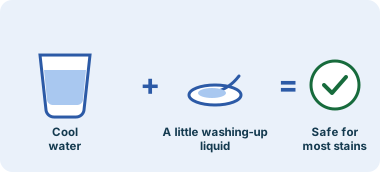
- Treat with a teaspoon of washing-up liquid and a tablespoon of white vinegar in 250ml of lukewarm water; dab and blot.
- Rinse and repeat patiently. Curry usually needs several gentle passes.
- Let daylight help by drying naturally near a window; sunlight can fade the last of the turmeric tint over a few days.
Please don't be tempted by bleach, on a coloured carpet it swaps an orange mark for a permanent pale one. If a shadow remains, that's exactly the sort of stain our professional extraction can often improve further.
By surface
🧹 Carpets
Most of these marks end up on the carpet, and the method above is exactly what we use, just at professional strength with proper rinse-extraction. If it’s set in, over a large area or won’t shift, our carpet cleaning service lifts what home kits leave behind.
🛋️ Sofas & upholstery
Check the cushion's cleaning code first: W or W/S means the method above is fine used sparingly; S means solvent-clean only, so leave that to a professional. Use less water than on carpet and blot, don't soak.
🧶 Wool & delicate rugs
Turmeric dyes natural fibres in minutes, so on a wool or silk rug treat a curry spill as an emergency. Blot now and get expert help fast rather than experimenting. Use cool water and a gentle touch. Wool can ‘brown’ if over-wet and some rug dyes run. Test a hidden corner first, and for an antique, hand-knotted or silk rug, don't gamble. Leave it to us.
🛏️ Mattresses
Turmeric is very persistent, so on a mattress expect to lighten it rather than fully erase it. You can't rinse a mattress, so go light: blot, treat sparingly, then use bicarbonate of soda to absorb the rest. Never soak it. Trapped moisture leads to mould and smells.
✅ Do
- Act fast and scrape solids first
- Be patient over several passes
- Let daylight help fade the tint
- Test on a hidden patch first
🚫 Don't
- Use bleach. It causes a permanent pale mark
- Scrub. It spreads the dye
- Use hot water
- Expect a guaranteed full removal
Tried it and the curry & turmeric mark is still there, or it's a wool rug, a mattress or something you'd hate to ruin? Don't keep scrubbing; that's how a stain turns permanent. We can often draw out what's left with professional hot-water extraction, and we'll tell you honestly what we expect to get up before we start. We usually reply within 15 minutes, prices are fixed with no VAT (rooms from £20, £50 minimum call-out), and we can normally fit you in within two to three days, worth sending that photo sooner rather than later, as the longer a stain sits, the harder it is to lift. Watford family business (25 years' experience, fully insured) and if you're not happy with the result, we re-clean free. That's our 100% satisfaction guarantee.
Get my free quote 💬 WhatsApp us a photo of the stainCommon questions
Can a professional carpet cleaner remove a curry stain completely?
Sometimes, but we'll be honest with you: turmeric behaves like a dye, and once it has set into the fibres it may never lift out fully. Professional hot-water extraction gives you the best realistic chance, especially on a fresh stain. If you'd like a straight answer before booking, WhatsApp us a photo and we'll tell you for free whether our carpet cleaning is likely to shift it, and if we don't think it will, we'll say so.
Why has my curry stain turned red or pink?
That's the turmeric reacting, not the stain getting worse. Curcumin, the yellow pigment in turmeric, changes colour when it meets anything alkaline, and many household cleaners and soaps are alkaline. Stop applying whatever caused the change, blot with plain cool water, and avoid experimenting further, as each new product can push the pigment deeper into the fibres.
Does sunlight really fade turmeric stains?
Yes. Curcumin breaks down in UV light, which is why turmeric-stained plastic tubs fade on a sunny windowsill. Unfortunately that's rarely practical for a fitted carpet, and strong sun on one patch can fade the carpet's own dyes along with the stain. Gentle blotting followed by a proper extraction clean is the safer route.
More stain guides
- ← Back to the full Stain Removal Guide
- How to remove red wine
- How to remove tea
- How to remove coffee

Last updated July 2026